Loading...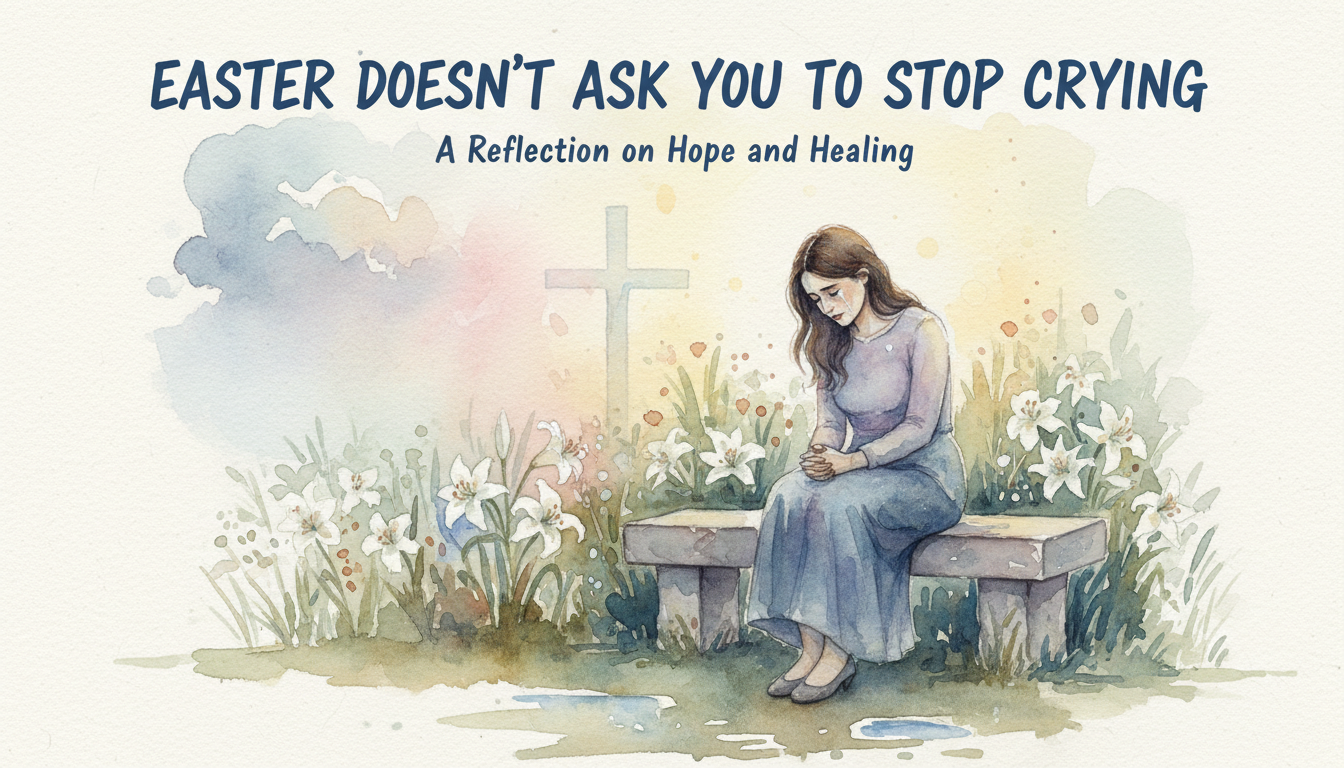
A theological reflection for anyone carrying grief this Eastertide
Last week, we asked how our neighborhood shapes our faith — how the specific streets, faces, and stories of this community find their way into our theology. This week, we're putting that question into practice. Because grief is here, right now, in our zip code. Families in Decatur are sitting with loss this Eastertide, navigating that strange and disorienting space where the world keeps moving and the heart cannot. If that describes you, or someone you love, this reflection is written for you.
And it begins with a confession the church doesn't always make clearly enough: Easter doesn't ask you to stop crying.
The Resurrection Happened in the Middle of Grief
We sometimes speak of Easter as though it erases what came before — as though the empty tomb is an answer that cancels the question of suffering. But look more carefully at the Gospel accounts, and a different picture emerges. Mary Magdalene stands weeping at the tomb even after she has heard the news of resurrection. Thomas is not a man of weak faith; he is a man in shock, still carrying the weight of Friday. The two disciples on the road to Emmaus walk away from Jerusalem in grief, saying, "We had hoped..." — past tense, hope in the rearview mirror.
Resurrection does not appear to these disciples as a solution to sorrow. It appears inside their sorrow. The risen Christ enters locked rooms. He walks alongside people who don't recognize him. He calls a grieving woman by name at the garden's edge. The season of Easter is not fifty days of triumphant certainty — it is fifty days of the risen Lord finding people exactly where they are, grief and all, and refusing to leave them there alone.
"Do not let your hearts be troubled, and do not let them be afraid."
Notice what Jesus does not say: he does not say, your hearts will not be troubled. He acknowledges the trouble. He names the fear. And then he promises his presence anyway. That is not toxic positivity. That is resurrection faith — the kind that knows sorrow intimately and still speaks of hope.
The Full Emotional Spectrum of Loss Belongs in Church
One of the most honest things we can say to a grieving person is that the church has room for all of it — not just the peaceful sadness we see in sympathy cards, but the raw edges of loss: the guilt, the doubt, the anger, the strange moments of relief, the fear that faith isn't enough or never was. The brothers of the Society of Saint John the Evangelist, in their daily devotional for this season, offer language that reaches into exactly that territory — naming God's love as present and unconditional even when we cannot feel it, even when doubt or guilt have made us feel unworthy of comfort.[1]
That kind of honesty is what grieving people are often starving for. Many who have stepped away from church did so in part because the church seemed to offer only answers when they were still living in the question. Eastertide, read carefully, is not about answers. It is about accompaniment. It is about a God who shows up in the garden, on the road, in the upper room — wherever the grief has taken you.
A reflection published this week by Grow Christians draws a striking image: the way a graduation and a gravesite can occupy the same season, even the same week — endings and beginnings braided together in ways that resist easy resolution.[2] That is the texture of real life. And it is, perhaps surprisingly, the texture of Easter as well. The liturgical season holds both, and so can we.
What the Lectionary Gives Us Permission to Name
This past Sunday — the Second Sunday of Easter — parishes across the Episcopal Church and throughout the wider Christian family heard the story of Thomas. Preachers around the country found themselves speaking not just about doubt, but about fear, about grief, about the courage it takes to stay in community when your heart is broken.[3] The lectionary, in other words, has already opened this door. The church is already in this conversation.
The Book of Common Prayer carries this same pastoral wisdom in its burial liturgy, where we pray not that grief would be avoided, but that it would be borne — held in the confidence of resurrection hope. There is a difference between being spared sorrow and being accompanied through it. The Christian tradition, at its best, has always promised the latter.
"Even at the grave we make our song: Alleluia, alleluia, alleluia."
Alleluia at the grave. Not instead of the grave. Not after the grief has passed. The hymn rises from inside the loss — and that changes everything about what we mean when we say "Easter people."
You Are Welcome Here, Exactly as You Are
If you are in a season of loss — whether you lost someone recently or have been carrying grief for years; whether you are a lifelong churchgoer or haven't been inside a sanctuary in decades — this parish is not waiting for you to have it together before you walk through the door. We are not a congregation that has mastered grief. We are a community that is learning, Sunday by Sunday, how to hold one another in it.
Our clergy are available to anyone in this community who needs to talk, to pray, or simply to sit in silence with someone who won't try to fix what cannot be fixed. You don't need to be a member. You don't need to explain yourself. A phone call or an email is enough.
As Eastertide continues toward Pentecost, we invite you to consider joining us — for Sunday worship, for a quiet conversation over coffee, or simply to light a candle and rest in a space that has held sorrow and hope together for a very long time. The season is still open. The door is still open. And if the risen Christ is to be found anywhere, it is among people who are honest enough to admit they are still learning what resurrection means.
We would be honored to learn alongside you.
Reach out to our pastoral care team:
Contact the parish office to speak with a member of the clergy or to request a pastoral visit. We welcome calls, emails, and walk-ins — no appointment required. You are not a stranger here.
References
- Society of Saint John the Evangelist (SSJE). "Brother, Give Us a Word: Comfort." SSJE Daily Devotional, April 17, 2026. www.ssje.org
- Cooper, Emily. "How It Ends: Sister Emily Cooper, Graduations, and Graves." Grow Christians, April 17, 2026. growchristians.org
- St. James Episcopal Church. "Finding Peace Amid Fear: A Homily for the Second Sunday of Easter." April 16, 2026. stjamesepiscopal.com