Loading...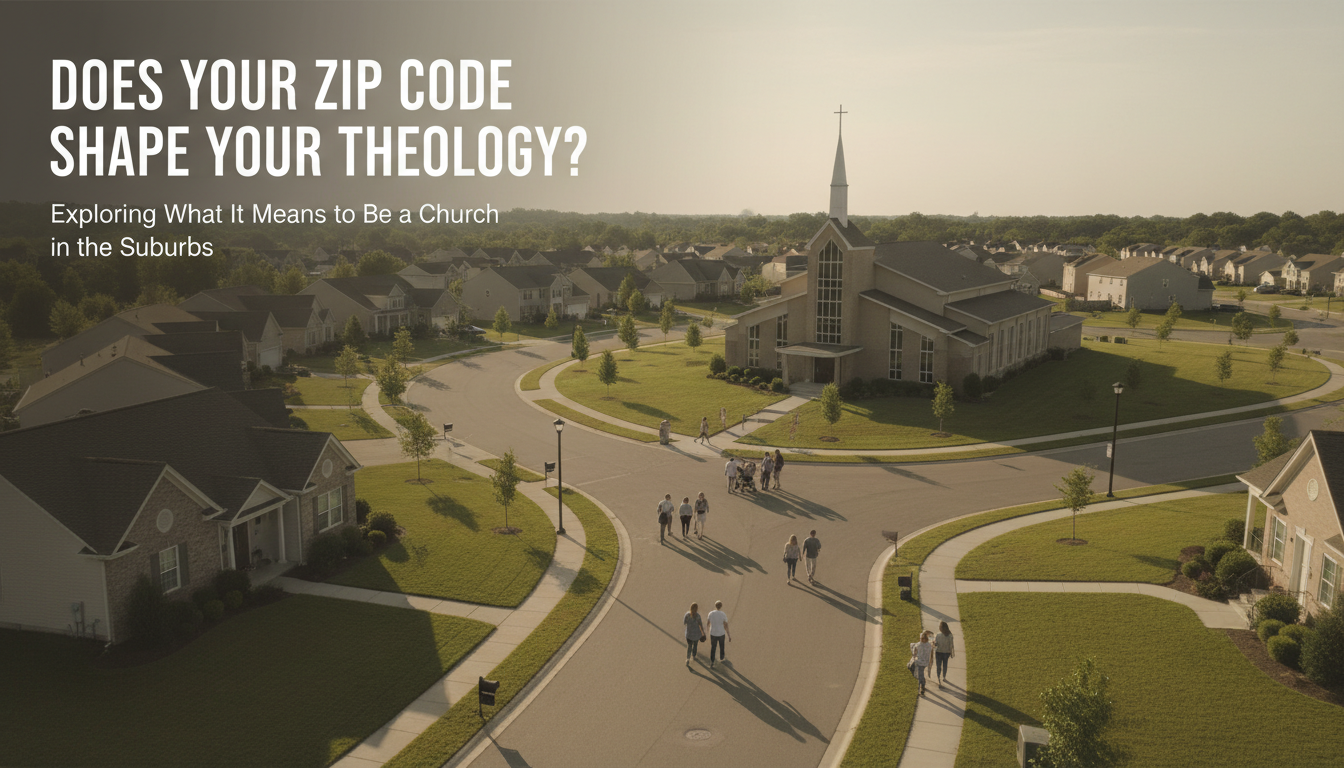
Does Your Zip Code Shape Your Theology? Exploring What It Means to Be a Church in the Suburbs
Most of us don't spend much time thinking about how our neighborhood shapes our faith. We think about Scripture, prayer, community, service — the classic building blocks of Christian life. But what if the layout of our streets, the design of our homes, and the rhythms of suburban living were quietly shaping us in ways we've never examined? What if where we live is forming — or perhaps deforming — how we love our neighbors? These are not abstract academic questions. They are deeply practical, deeply spiritual ones, and they deserve our honest attention.
The Geography of Separation
Suburban life is, by design, organized around separation. Homes are set back from the street. Yards are fenced. Driveways lead directly into garages. Errands are run by car, alone, with earbuds in. None of this is malicious — in fact, much of it is genuinely comfortable and appealing. But comfort and convenience, left unexamined, can quietly erode something essential about Christian community.
The concept sometimes called "suburb theology" invites us to look honestly at this geography and ask what it teaches us — not intentionally, but structurally — about our obligations to one another.[1] When our physical environment is engineered for privacy and self-sufficiency, it becomes very easy to live as though we don't need our neighbors, and as though they don't need us. That posture, however understandable, runs directly counter to the Gospel.
"You shall love your neighbor as yourself." — Mark 12:31
The command is clear. But who is our neighbor when we rarely see them, rarely walk past their door, rarely share a common space? The suburban landscape can make neighborliness feel optional in a way that a dense urban block or a small rural town simply does not. That's worth sitting with.
Privacy, Convenience, and the Formation of the Self
One of the quietest dangers of suburban life isn't hostility — it's indifference. When we can meet nearly every need privately (the home office, the home gym, the streaming service, the Amazon delivery), the friction that once drew people together simply disappears. And with it, sometimes, goes the habit of depending on others.
Christian formation has always understood that we are shaped by our habits and our environments. The Book of Common Prayer itself is structured around daily rhythms, communal gathering, and repeated actions — because the Church knows that we become what we practice.[1] When our daily practices are increasingly solitary and self-contained, it's worth asking: what kind of person is that forming us into? What kind of Christian?
"We are incorporated into the Body of Christ... We are members one of another." — Book of Common Prayer, p. 855
This is not a guilt trip. Most of us didn't choose suburban life as a theological statement. We moved here for good schools, or affordability, or family, or simply because it's where we landed. The invitation isn't condemnation — it's awareness. Awareness is where transformation begins.
A Church That Crosses the Street
Here is the hopeful part: the Church, at its best, has always been a counter-formation. It gathers people across the invisible fences that culture erects. It names strangers as siblings. It calls us out of our private comfort and into a shared life. A parish rooted in the suburbs doesn't have to be a suburban parish in the limiting sense — insular, homogeneous, self-congratulatory. It can be something far more interesting and far more faithful.
What might it look like for our congregation to intentionally push against the isolating tendencies of suburban geography? It might look like walking to a neighbor's door instead of sending a text. It might look like learning the names of the families we pass in the school pickup line. It might look like our parish actively building relationships with communities across town — communities whose daily experience of this city looks very different from our own.[1] It might look like asking, in our small groups and our vestry meetings and our coffee hour conversations: who is not in this room, and why?
The season of Pentecost, which carries us through the long green months of summer, is traditionally understood as the season of the Church in the world — the season when the Spirit blows outward, scattering the disciples into streets and neighborhoods and foreign cities. It is a fitting time to ask what it means to be scattered into ours.
An Invitation to Wrestle Together
This summer, we invite you to take these questions seriously — not alone, but together. In the coming weeks, we'll be offering small-group conversations rooted in the themes of place, community, and Christian obligation. No expertise required. No perfect answers expected. Just honest conversation among people who are trying to follow Jesus in the particular time and place where they find themselves.
In the meantime, consider a small practice: this week, introduce yourself to a neighbor you don't yet know by name. Or take a walk through your neighborhood without your phone, noticing who and what you see. Or simply sit with this question in your morning prayers:
Lord, show me my neighbor. Give me eyes to see, and courage to cross the distance between us.
Our zip code does not have to determine our theology. But it is a good place to start asking the question.
References
- "Suburb Theology." St. Anne's Episcopal Church (Brave: Episcopal Church News). St. Anne's Episcopal Church, Annapolis, MD. Accessed 2024. https://www.stannes-annapolis.org/news/z85b6dx2fswbg682rew2cbx9jff6b4-tn89r-3dnn4-weeh4